Last reviewed on October 31, 2026.
What jobs are there in computational cognitive science?
Computational cognitive science is a small research niche, but its skills lead to a much larger job market. Graduates work as academic researchers, research scientists and engineers at AI labs, machine learning engineers, data scientists, AI evaluation specialists and computational researchers in health. No official statistics count this niche. The closest US figures are for computer and information research scientists (median pay $140,300 in May 2025, 22% projected growth for 2025-35) and data scientists ($120,230, 35%). Few jobs carry the name, so search by role and skill.
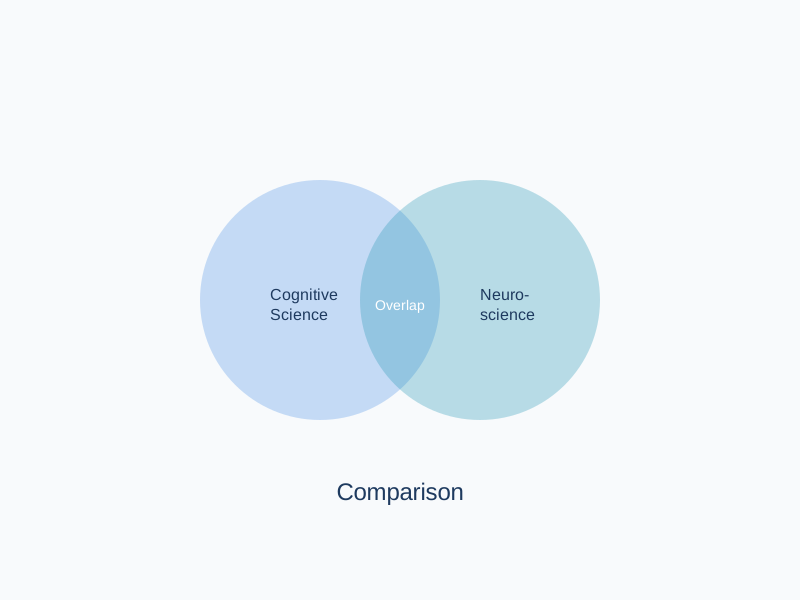
Computational cognitive science tries to explain thinking by building working models of it, usually as programs that can be tested against human behavior. Griffiths, Chater and Tenenbaum (2024) give a book-length account of one major approach, Bayesian modeling. It shares much of its toolkit with machine learning, and the two have influenced each other for decades: the 1986 backpropagation paper by Rumelhart, Hinton and Williams came partly out of a cognitive science institute at UC San Diego.
That overlap explains why career advice in this area is confusing. The academic niche is small, while the adjacent job market is large and competitive. This article separates the two. Our careers guide covers the wider field, and AI and cognitive science explains how the disciplines connect.
Is there demand for computational cognitive science?
There is no reliable answer for the niche itself. We know of no government labor-market dataset, in the US or elsewhere, that counts computational cognitive scientists, and any precise figure or country ranking you see for this title should be treated as invented. What we can do is look at adjacent occupations. BLS figures cover everyone in these jobs, most of whom have no cognitive science training.
| BLS occupation (US) | Jobs, 2025 | Median annual wage (May 2025) | Projected growth, 2025-35 | Openings per year | Typical entry education |
|---|---|---|---|---|---|
| Computer and information research scientists | 38,600 | $140,300 | 22% | About 2,900 | Master's |
| Data scientists | 275,600 | $120,230 | 35% | About 24,800 | Bachelor's |
Two points follow from these numbers. First, growth is strong, but “research scientist” is a small occupation with about 2,900 openings a year, most of which replace people who leave. Second, these are jobs for which you compete with computer science, statistics and physics graduates. The BLS also reports that the federal government is the largest single employer of computer and information research scientists, at 31%, followed by computer systems design at 16% and scientific research and development at 14%, a reminder that the category is broader than AI startups.
Projections carry uncertainty, and tech hiring moves quickly. Check live job ads in your target region before making decisions.
Computational cognitive science jobs
Few employers use the phrase, so search for these titles instead.
- Faculty and postdoctoral researcher. In psychology, cognitive science, computer science or linguistics departments. Faculty jobs are the classic goal and are scarce.
- Research scientist or research engineer. In AI labs and large technology companies. These roles usually look for a strong publication record in machine learning, and research-heavy posts commonly expect a PhD even though the BLS lists a master's as the typical entry level for the occupation as a whole.
- AI evaluation and behavioral research. Designing tests of what language models can do and studying how people use and rely on them. Experiment design skills apply directly here.
- Machine learning engineer or data scientist. More common than research roles, and more dependent on software skills than cognitive theory.
- Computational health research. Computational psychiatry, for example, uses models of behavior and brain function to try to improve clinical prediction and treatment (Huys et al., 2016). It is still mainly a research field.
- Quantitative user research and experimentation. Product teams use behavioral modeling and A/B testing to understand users.
Where are computational cognitive scientists most hired?
By sector, the main employers are universities and research institutes, AI and technology companies, and health technology. No dataset gives the split for this niche.
The nearest data concerns AI PhDs. According to the Stanford AI Index (2026), drawing on the Computing Research Association's survey, about 63% of new AI PhDs in the US and Canada took industry jobs in 2024 and about 32% went into academia. The same report says recent growth in AI PhDs has gone into academia, reversing a long trend. These are computer science graduates, so treat this as context only.
Top countries for computational cognitive science careers
No ranking of countries exists for this field, and we will not make one up. The closest proxy covers elite machine learning researchers, a related but different group. A Carnegie Endowment analysis of authors at the NeurIPS machine learning conference found that in 2025 about 41% worked in China and 34% in the United States, compared with 27% and 46% in 2022 (Ma & Yang, 2026). That rests on one conference and on self-reported profiles, and its authors are more confident about the US-China findings than other regions.
For practical planning, ask a narrower question: which specific labs work on what you want to do, and can you legally work there? Visa rules, language and funding often matter more than national rankings. Our careers guide mentions several research hubs. The authors of papers you admire are the best guide to where the work is done.
Skills for a cognitive science, AI and machine learning career
Technical
- Python and research software habits such as version control and testing.
- Probability and statistics, including Bayesian inference and mixed-effects models.
- Linear algebra and calculus at the level needed to read machine learning papers.
- Machine learning, including deep learning frameworks such as PyTorch, and working with language models.
- Model fitting and comparison. Wilson and Collins (2019) set out ten rules for doing this well with behavioral data, and it is a good place to start.
Scientific
- Experimental design: controls, confounds, power and pre-registration. This is often the skill that sets a cognitive scientist apart from an engineer.
- Measurement: working out what a test actually captures, which applies directly to evaluating AI systems.
- Domain knowledge of memory, language or decision making.
- Communication: explaining a model and its limits to non-specialists.
Cognitive neuroscience and AI career path
Neuroscience and AI have long borrowed from each other, a history reviewed by Hassabis and colleagues (2017), and deep learning models are now used as models of the brain itself (Yamins & DiCarlo, 2016). A cognitive neuroscience background can lead to AI work, but the move usually takes deliberate retraining. Imaging experience alone will not be enough for most machine learning roles.
A common path looks like this:
- Choose a cognitive neuroscience lab that does substantial computational work, not only data collection.
- Build a project that uses machine learning, such as decoding from brain data or comparing neural networks with neural recordings.
- Publish code and take machine learning courses during the degree.
- Apply for internships before finishing, since these often count for more than the thesis topic in industry hiring.
Career outcomes after a cognition or neuroscience PhD
We found no reliable public dataset showing what share of cognition and neuroscience PhDs go into data science or AI. Be cautious of programs that quote outcomes without saying how they were measured, and ask each department for its own placement record.
What is well documented is a mismatch between training and careers. Akil and colleagues (2016) argued that neuroscience training should build deeper quantitative and computational skills and prepare students for a wider range of careers than academia alone. In practice, many PhD students in this area do find work in data science and technology, and the ones best placed are those who have done real programming and statistics. A cognitive science degree without those skills will not lead there automatically.
Cognitive AI career path by starting point
“Cognitive AI” has no fixed meaning. It may refer to AI inspired by human cognition, as argued by Lake and colleagues (2017), or simply be marketing. Check what a job ad actually involves.
- Undergraduate student. Take a cognitive science major with a computing track, or computer science with cognitive science electives. Join a modeling lab.
- Computer science graduate. You already have the hardest part for industry. Add coursework in cognition and a human-behavior project, or apply directly to computational cognitive science labs.
- Psychology or neuroscience graduate. Spend a year on Python, statistics and machine learning. A master's in data science or computational neuroscience is one option, and open-source projects are another.
- PhD student. Get an internship and leave with a public portfolio. Decide early if you want to keep the academic route open, because that means prioritizing publications.
Is computational cognitive science a good career choice?
It is a good choice if you want the questions as much as the job. The skills are in demand, and they let you move into adjacent work if academia does not work out. It is a poor choice if your only aim is an AI salary, since a direct computer science route is shorter. Some of the demand also depends on a fast-moving AI industry, so build skills that will last, such as statistics, experimental design and clear thinking about what a model shows.
Frequently Asked Questions
Is there demand for computational cognitive science?
There is no official data for the niche itself. Demand for adjacent skills is strong: the BLS projects 22% growth for computer and information research scientists and 35% for data scientists from 2025 to 2035. Jobs labeled computational cognitive science remain rare, and most are in academia.
Where are computational cognitive scientists most hired?
Mainly in universities and research institutes, AI and technology companies, and health technology. No dataset shows the split. As a rough comparison, about 63% of new AI PhDs in the US and Canada went into industry in 2024, according to the Stanford AI Index.
What are the top countries for computational cognitive science careers?
There is no reliable ranking for this field. Among authors at the NeurIPS machine learning conference, a related but different group, one 2026 analysis found about 41% worked in China and 34% in the United States in 2025. Choose by specific labs and work rights, not by a country list.
What skills do I need for a cognitive science career in AI?
Python, probability and statistics, linear algebra, machine learning and model fitting are the technical core. Experimental design and measurement are the skills that most often set cognitive scientists apart from engineers.
Can I move from cognitive neuroscience into AI?
Yes, but it usually takes deliberate retraining. Choose computational projects, build a public code portfolio, learn machine learning properly and try to get an industry internship before you finish your degree.
How much do computational cognitive scientists earn?
There is no separate pay figure. In May 2025 the BLS median was $140,300 for computer and information research scientists and $120,230 for data scientists in the US. Academic pay is usually lower.
Sources
- Griffiths, T. L., Chater, N., & Tenenbaum, J. B. (2024). Bayesian Models of Cognition: Reverse Engineering the Mind. MIT Press. doi:10.7551/mitpress/8765.001.0001
- Rumelhart, D. E., Hinton, G. E., & Williams, R. J. (1986). Learning representations by back-propagating errors. Nature, 323(6088), 533-536. doi:10.1038/323533a0
- Wilson, R. C., & Collins, A. G. E. (2019). Ten simple rules for the computational modeling of behavioral data. eLife, 8, e49547. doi:10.7554/eLife.49547
- Huys, Q. J. M., Maia, T. V., & Frank, M. J. (2016). Computational psychiatry as a bridge from neuroscience to clinical applications. Nature Neuroscience, 19(3), 404-413. doi:10.1038/nn.4238
- Hassabis, D., Kumaran, D., Summerfield, C., & Botvinick, M. (2017). Neuroscience-inspired artificial intelligence. Neuron, 95(2), 245-258. doi:10.1016/j.neuron.2017.06.011
- Yamins, D. L. K., & DiCarlo, J. J. (2016). Using goal-driven deep learning models to understand sensory cortex. Nature Neuroscience, 19(3), 356-365. doi:10.1038/nn.4244
- Lake, B. M., Ullman, T. D., Tenenbaum, J. B., & Gershman, S. J. (2017). Building machines that learn and think like people. Behavioral and Brain Sciences, 40, e253. doi:10.1017/S0140525X16001837
- Akil, H., Balice-Gordon, R., Cardozo, D. L., Koroshetz, W., Posey Norris, S. M., Sherer, T., Sherman, S. M., & Thiels, E. (2016). Neuroscience training for the 21st century. Neuron, 90(5), 917-926. doi:10.1016/j.neuron.2016.05.030
- U.S. Bureau of Labor Statistics. Computer and information research scientists. Occupational Outlook Handbook (May 2025 wages, 2025-35 projections). bls.gov
- U.S. Bureau of Labor Statistics. Data scientists. Occupational Outlook Handbook (May 2025 wages, 2025-35 projections). bls.gov
- Stanford Institute for Human-Centered AI. (2026). Education. In The AI Index 2026 Annual Report. hai.stanford.edu
- Ma, D., & Yang, B. (2026, September 23). Who's ahead in the global AI talent race? Carnegie Endowment for International Peace. carnegieendowment.org