Psychology
The scientific study of behavior and mental processes. Cognitive psychology examines perception, memory, attention, language and problem solving.
Learn moreWelcome to CognitiveScientist.net – your hub for exploring how minds and machines think, learn and interact. Dive into articles about memory, perception, language, AI, neuroscience, psychology and beyond.
Cognitive science is the interdisciplinary study of mind and intelligence. It brings together psychology, neuroscience, artificial intelligence, linguistics, philosophy and anthropology to understand how we perceive, remember, think, learn, communicate and act. Modern cognitive science investigates everything from the neural circuits underlying vision to the algorithms behind machine learning and the cultural influences that shape human reasoning.
Short answer: what is cognitive science?
Cognitive science is the scientific study of the mind as an information-processing system. It asks how people (and animals and machines) take in information, represent it, transform it and use it to act, and it answers those questions by combining experiments, brain measurements and computational models from six fields: psychology, neuroscience, AI, linguistics, philosophy and anthropology. A cognitive scientist is a researcher or practitioner who uses those tools to explain or build intelligent behaviour.
The field took shape during the cognitive revolution of the 1950s, when psychologists, linguists and early computer scientists rejected the behaviourist idea that the mind was off-limits to science. The term “cognitive science” itself dates from the 1970s, and the Cognitive Science Society was founded in 1979. Our history of cognitive science traces the full story.
Cognitive science is defined less by a single method than by a shared set of questions. Among the most important:
The scientific study of behavior and mental processes. Cognitive psychology examines perception, memory, attention, language and problem solving.
Learn more
Explores the nervous system and the neural basis of cognition. Cognitive neuroscience links brain activity to mental functions such as vision, language and emotion.
Learn more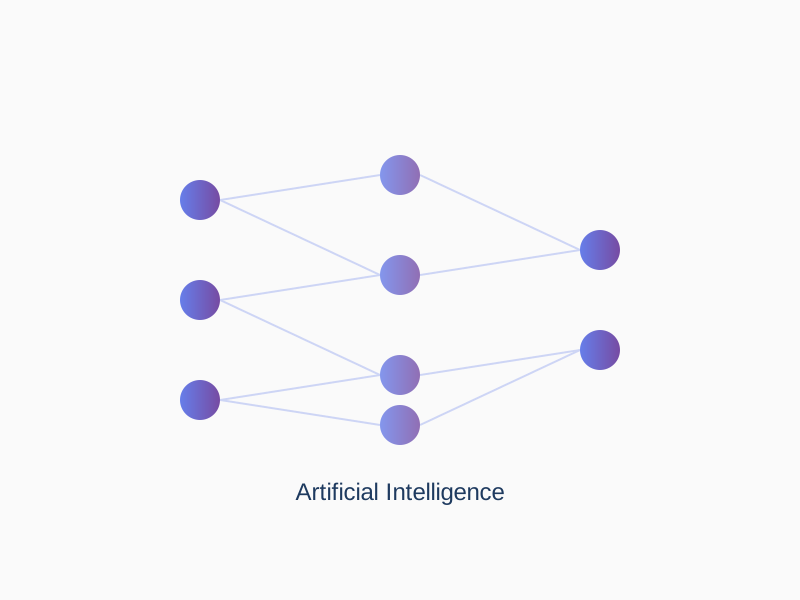
Designs intelligent machines and models cognitive processes. AI uses algorithms, machine learning and neural networks to simulate aspects of human intelligence.
Learn more
Studies the structure and use of language. Cognitive linguistics looks at how we acquire, process and produce language in the mind.
Learn more
Addresses fundamental questions about mind, knowledge and consciousness. Philosophy of mind investigates the nature of mental states and their relationship to the brain.
Learn more
Examines human societies and cultures. Cognitive anthropology explores how culture influences cognition and how cognitive processes shape cultural practices.
Learn moreOne reason cognitive science needs several disciplines is that a mental process can be explained at different levels. The vision scientist David Marr, in his book Vision (1982), proposed three levels that are still the standard way to organise explanations:
The levels constrain each other but are not interchangeable. Knowing which neurons fire during a memory task does not by itself tell you what the memory system is for, and a good algorithm is useless as a theory of the mind if the brain could not possibly implement it. Much of the field’s progress comes from connecting findings across levels.
The founding idea of cognitive science is that thinking involves mental representations (internal states that stand for things in the world) and computations that transform them. Early versions, inspired by digital computers and by Allen Newell and Herbert Simon’s work on problem solving, treated the mind as a manipulator of symbols and rules. From the 1980s, connectionism and neural networks offered an alternative in which knowledge is stored as patterns of connection strengths across many simple units — the ancestor of today’s deep learning.
Classical cognitive science sometimes treated the body as a mere input and output device. Embodied cognition argues instead that thinking is shaped by having a body that moves and acts in an environment: perception is tied to action, abstract concepts often borrow from bodily experience, and some cognitive work is offloaded onto tools and surroundings. How far this changes the classical picture is still debated.
A more recent unifying idea is that the brain is fundamentally a prediction machine. According to predictive processing, the brain continually generates expectations about incoming sensory signals and updates its internal model when those expectations are wrong. The framework aims to explain perception, attention, action and learning with one principle, and links naturally to Bayesian models of cognition and to machine learning.
A cognitive scientist studies how minds work — human, animal or artificial — by combining methods from several fields. Few people hold the job title “cognitive scientist”; most are known as cognitive psychologists, cognitive neuroscientists, computational modellers, psycholinguists, UX researchers or AI researchers, and they use cognitive science as their toolkit.
A researcher’s day often mixes several activities: designing or programming an experiment, testing participants in the lab or online, analysing data in R or Python, fitting a computational model, reading the literature and writing papers or grant proposals. In industry, a cognitive scientist working in UX research might instead spend the day running usability sessions, interviewing users and turning findings into design recommendations, while one in AI might evaluate how well a model’s behaviour matches human judgments. The common thread is turning a vague question about the mind into a measurable one. Our guide to research methods in cognitive science explains the main tools.
Universities and research institutes remain the classic employers, but many graduates work in technology companies (UX research, product design, data science, machine learning), healthcare (neuropsychology, clinical research, rehabilitation), education and educational technology, human factors and safety engineering, market and behavioural research, and government policy units. See applications of cognitive science for examples from each area.
The usual route is an undergraduate degree in cognitive science, psychology, neuroscience, linguistics or computer science, ideally with statistics and programming. Research careers normally require a master’s or PhD; industry roles such as UX research or data analysis are often open to graduates with a strong portfolio of projects. Read our overview of careers in cognitive science, the jobs you can get with a cognitive science degree, or our self-study guide if you want to learn the field on your own.
How memories are encoded, consolidated and retrieved, why we forget, and the evidence-based study techniques that make learning stick…
Read more
If biases make us irrational, why do they persist? The heuristics behind common biases, five explanations for why they exist and practical ways to decide better…
Read more
Discover the wide range of careers available to graduates with a cognitive science degree. From UX design and data analysis to neuroscience and AI development…
Read more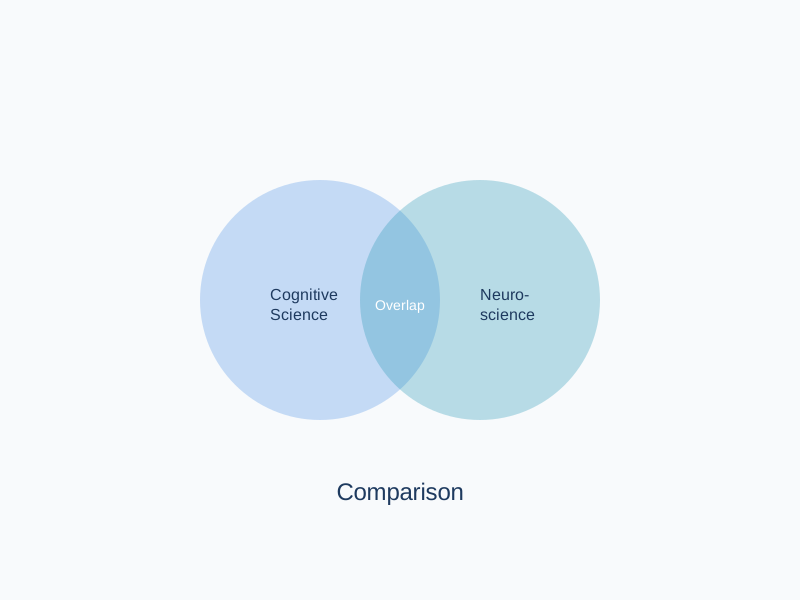
Both fields study the mind and brain, but they approach questions from different perspectives. Learn about their distinctions, overlaps and how they inform one another…
Read more
Explore how AI helps researchers model human cognition and how insights from cognitive science drive advances in machine learning and robotics…
Read more
Understand the stages of cognitive development, from early sensory exploration to abstract reasoning. Learn what influences cognitive growth and how to support it…
Read more
Follow the journey from ancient philosophers to the cognitive revolution and modern breakthroughs.
Discover
Learn about experimental techniques, brain imaging, computational models and more.
Explore
Discover how cognitive science is applied in AI, education, therapy, UX design and robotics.
Explore
How the body shapes the mind, the evidence behind it and the strongest objections.
Read
The brain as a prediction machine: an influential contemporary unifying framework.
Read
How people think through problems: search, insight, analogy and the limits of pure logic.
Read
A practical plan for studying cognitive science outside formal degree programmes.
ReadCognitive science is the interdisciplinary scientific study of the mind and its processes, such as perception, attention, memory, language, reasoning and learning. It treats thinking as a form of information processing and combines psychology, neuroscience, artificial intelligence, linguistics, philosophy and anthropology to explain how minds, natural or artificial, work.
No. Cognitive psychology is one of its core disciplines, but cognitive science is broader: it also draws on neuroscience, computer science and AI, linguistics, philosophy and anthropology, and it puts more weight on formal and computational models. Many cognitive scientists are trained as psychologists, so in practice the boundary between cognitive psychology and cognitive science is blurry.
A cognitive scientist studies how the mind works by designing experiments, measuring behaviour or brain activity, building computational models and testing theories against data. They work in universities and research institutes, in technology companies (often in AI, UX research or data science), and in healthcare, education and government.
It can be, especially for students who enjoy both people and technical problems. The degree combines statistics, programming, experimental design and critical reasoning, skills that transfer to UX research, data analysis, AI, education and graduate study in psychology or neuroscience. Because the field is broad, graduates do best when they also build a concrete specialism such as programming, neuroscience or design.
No single person founded it. It grew out of the cognitive revolution of the 1950s, driven by figures such as George Miller, Noam Chomsky, Allen Newell, Herbert Simon, Marvin Minsky, John McCarthy and Jerome Bruner. Christopher Longuet-Higgins is credited with coining the term cognitive science in 1973, the journal Cognitive Science began in 1977 and the Cognitive Science Society was founded in 1979.